
Contents
AI uses electricity because AI is computation
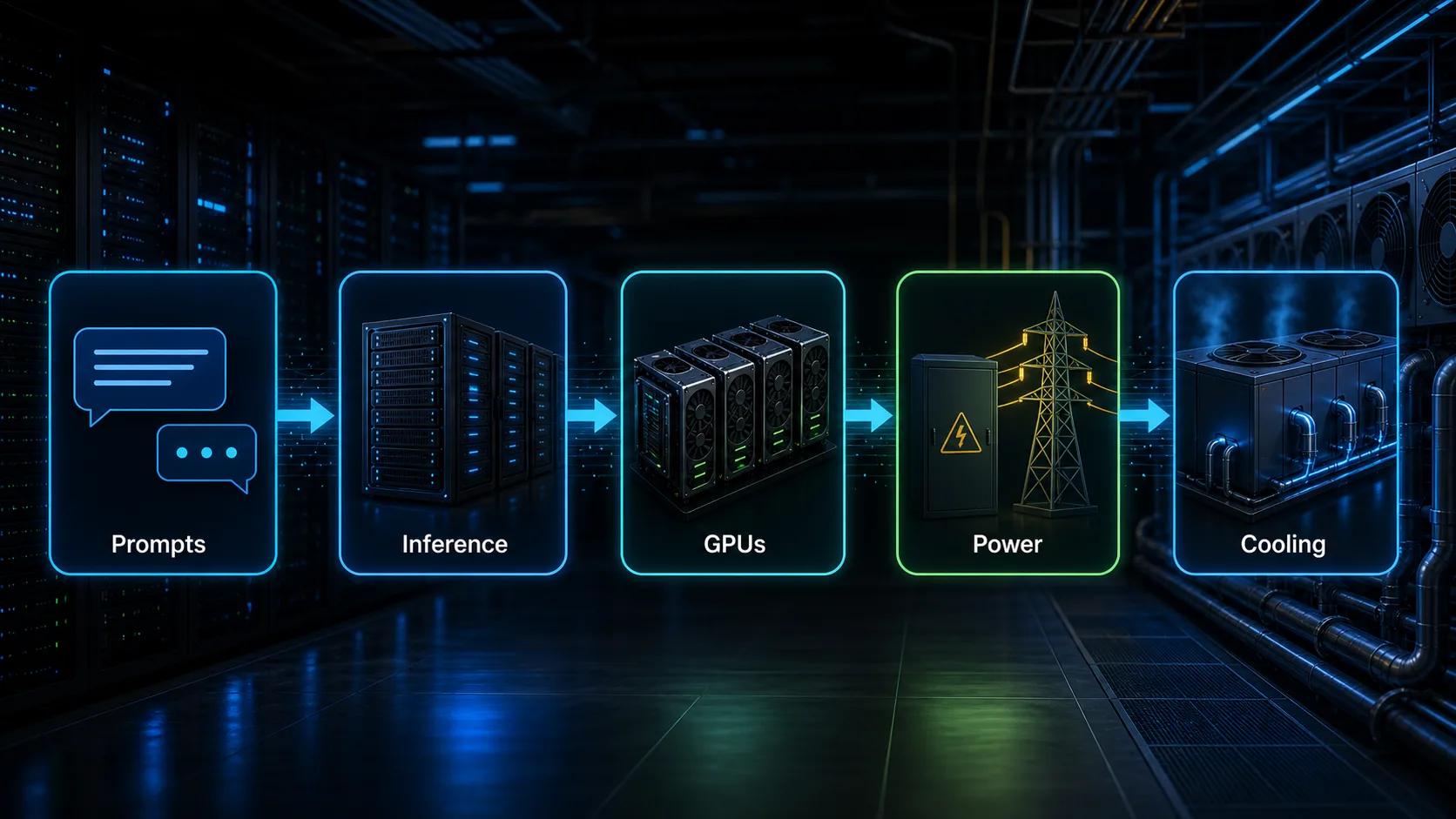
AI systems do not answer from a static list of stored responses. When a user sends a prompt, uploads an image or calls an AI API, the system runs mathematical operations through a trained model to produce an output.
Those operations require processors, memory, networking and storage. A single request can be small, but modern AI products may handle enormous traffic across chatbots, search assistants, coding tools, image generators and business applications.
That is why energy use is inseparable from AI infrastructure. The visible experience may be a short answer on a screen, but behind it are chips, servers, datacenters, cooling equipment and power systems doing physical work.
GPUs are powerful but energy-intensive
Modern AI relies heavily on GPUs because neural networks involve many calculations that can be performed in parallel. GPUs are designed for this kind of parallel computation, making them far more suitable than CPUs for many training and inference workloads.
The tradeoff is that high-performance GPU servers draw substantial power, especially when they run at high utilization in clusters. A large AI deployment may connect many accelerators with fast networking so they can share data and keep computations synchronized.
This does not mean GPUs are inefficient for AI. In many cases they are the efficient choice for the task. But because the tasks are large and continuous, GPU clusters become one of the most visible sources of AI electricity demand.
Training large models consumes concentrated energy
Training is the phase where a model learns from data. Large training runs may process huge datasets over many repeated steps, adjusting billions of parameters until the model becomes useful for prediction, generation or classification.
This work can keep large GPU clusters running for days, weeks or longer. The energy demand is concentrated because many accelerators, storage systems and networks operate together during the same training job.
Training is not the only part of AI energy use, but it is important because frontier model development, experimentation and retraining can require intense bursts of electricity and substantial datacenter capacity.
Inference creates continuous energy demand
Inference is the phase where a trained model is used. Every ChatGPT-style response, image generation, translation, recommendation, summarization or coding suggestion requires inference computation.
Unlike training, inference happens whenever people use deployed AI systems. If a service handles millions or billions of prompts, image requests and API calls, small amounts of energy per request can add up to significant daily demand.
This is why AI energy use is increasingly connected to adoption. The more AI is embedded into search, office tools, software development, customer support, media production and mobile devices, the more inference infrastructure has to run continuously.
Datacenters add infrastructure overhead
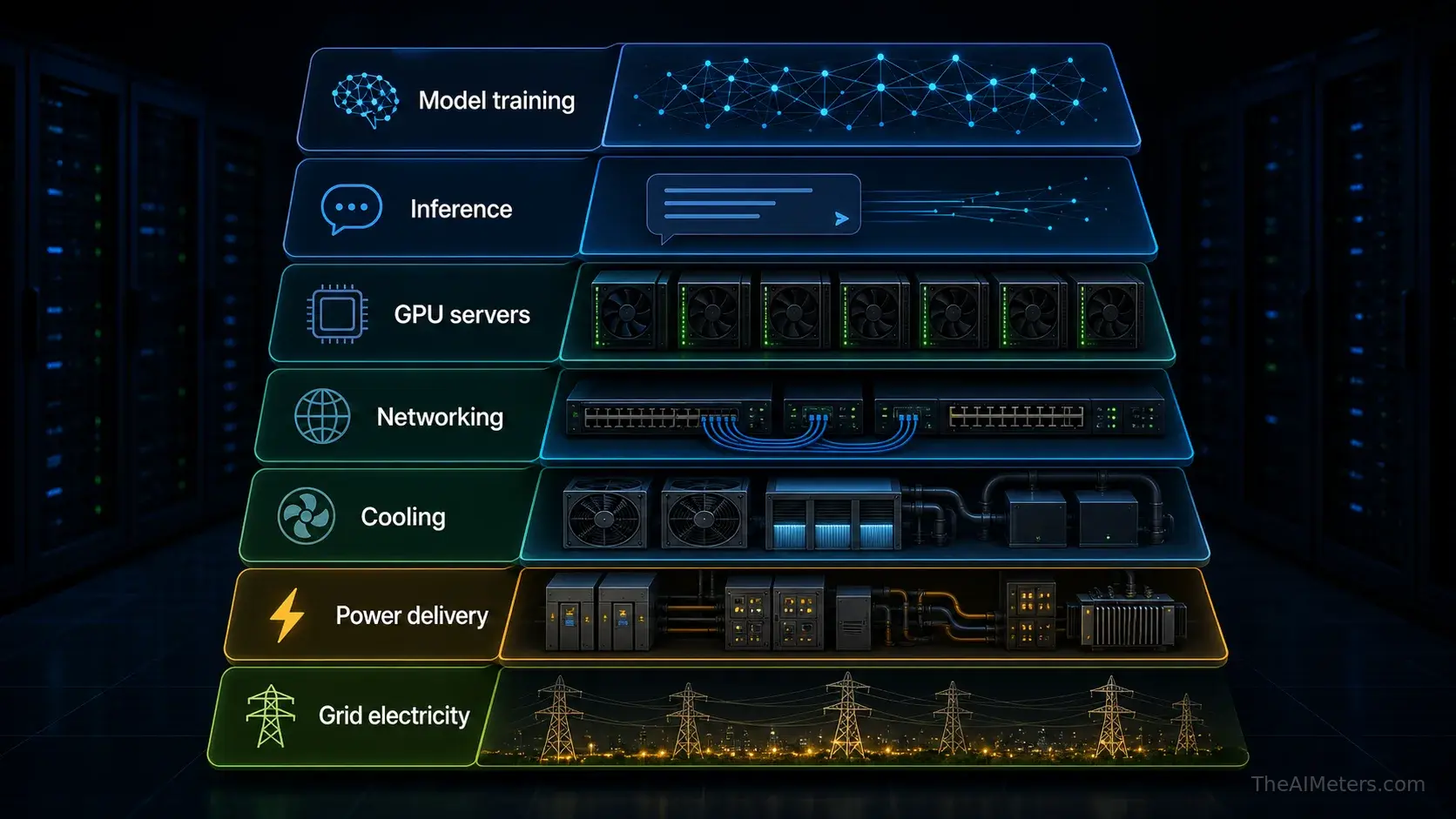
AI hardware operates inside datacenters, and the GPUs are only part of the electricity story. Servers need memory, storage, networking equipment, power supplies and backup systems. Data has to move between machines, racks and sometimes regions.
Cooling also matters. High-density AI servers generate substantial heat, so facilities use air cooling, liquid cooling, chillers, pumps, fans or heat exchangers to keep equipment within safe operating temperatures.
Datacenter efficiency is often summarized through power usage effectiveness, or PUE. A lower PUE means more of the electricity is used by computing equipment rather than facility overhead, but no large datacenter operates with zero supporting energy. The Stanford AI Index 2026 similarly separates AI chip power from cooling, networking and other infrastructure overhead when estimating AI data center power capacity.
Why AI electricity estimates vary so much
Public estimates vary because most AI providers do not disclose complete real-time energy use by model, product or request type. Researchers and analysts often have to combine public adoption signals, hardware assumptions, model size estimates, datacenter efficiency ranges and independent reports such as the Stanford AI Index.
The result depends on many variables: model size, token count, image resolution, hardware generation, utilization, batching, memory bandwidth, geographic location, electricity mix and whether the system is training, serving inference or sitting idle.
For that reason, AI electricity figures should usually be treated as directional estimates rather than exact official measurements. The useful question is often not one single number, but which factors make energy use rise or fall and whether different sources point to the same overall direction.
Can AI become more energy-efficient?
AI can become more efficient at the level of a comparable task. Better chips, improved model architectures, quantization, caching, batching, distillation and routing to smaller models can reduce the computation needed for useful outputs.
Datacenters can also improve through better cooling, higher hardware utilization, cleaner electricity procurement and more efficient power delivery. These improvements matter because they reduce waste and can lower energy per request.
The harder question is total demand. If efficiency improves but AI use grows faster, total electricity consumption may still increase. A balanced view has to track both sides: efficiency per task and the scale of global AI adoption, including the rapid growth in AI compute capacity documented by external research.