
Contents
What is an AI datacenter?
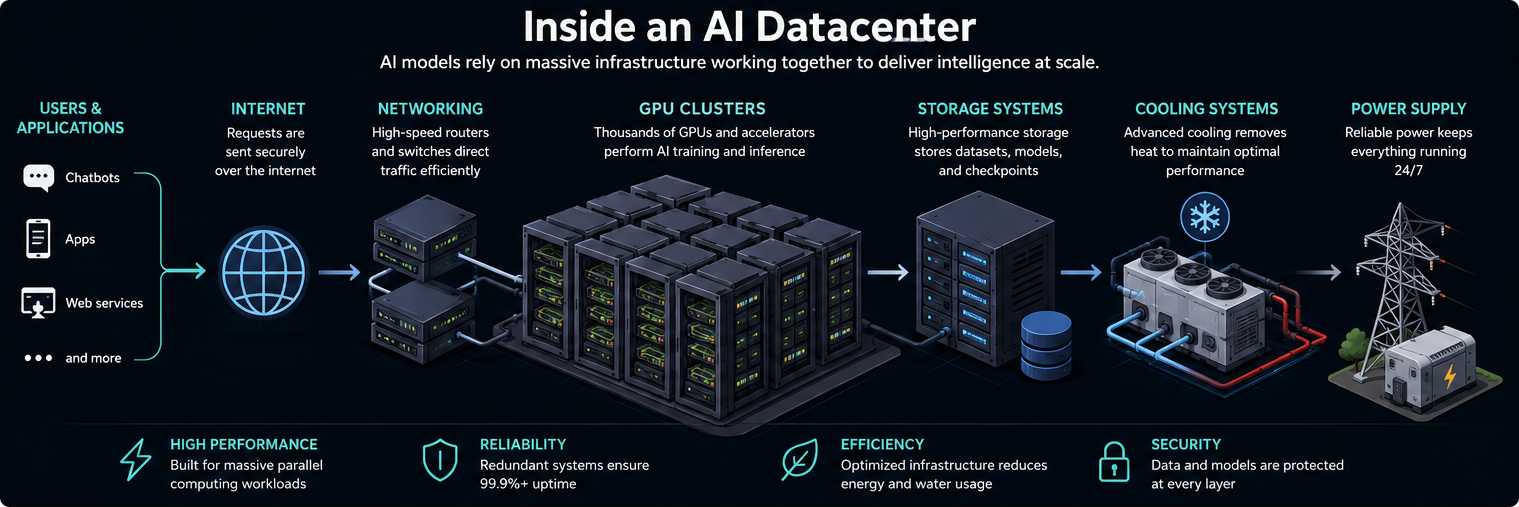
An AI datacenter is a specialized facility designed to run artificial intelligence workloads at very large scale. Unlike traditional web hosting infrastructure, AI datacenters are optimized for high-performance computation using thousands of GPUs and accelerators working simultaneously.
These facilities power services such as large language models, AI image generation, recommendation systems, autonomous systems, and scientific AI applications. Companies including OpenAI, Google, Microsoft, Meta, and Anthropic all rely on massive AI infrastructure.
Modern AI workloads require enormous computational density, networking bandwidth, and energy delivery systems compared to conventional cloud services.
GPUs and AI accelerators
Most modern AI systems rely on GPUs because they are highly efficient at parallel mathematical operations. AI training and inference involve billions or trillions of calculations that can be distributed across many processing cores simultaneously.
AI datacenters often contain clusters of high-end accelerators connected together with ultra-fast networking technologies. These GPU clusters can scale from dozens of machines to tens of thousands of processors working together.
As AI models continue to grow larger and more capable, demand for advanced accelerators and specialized AI chips continues to increase worldwide.
Training vs inference
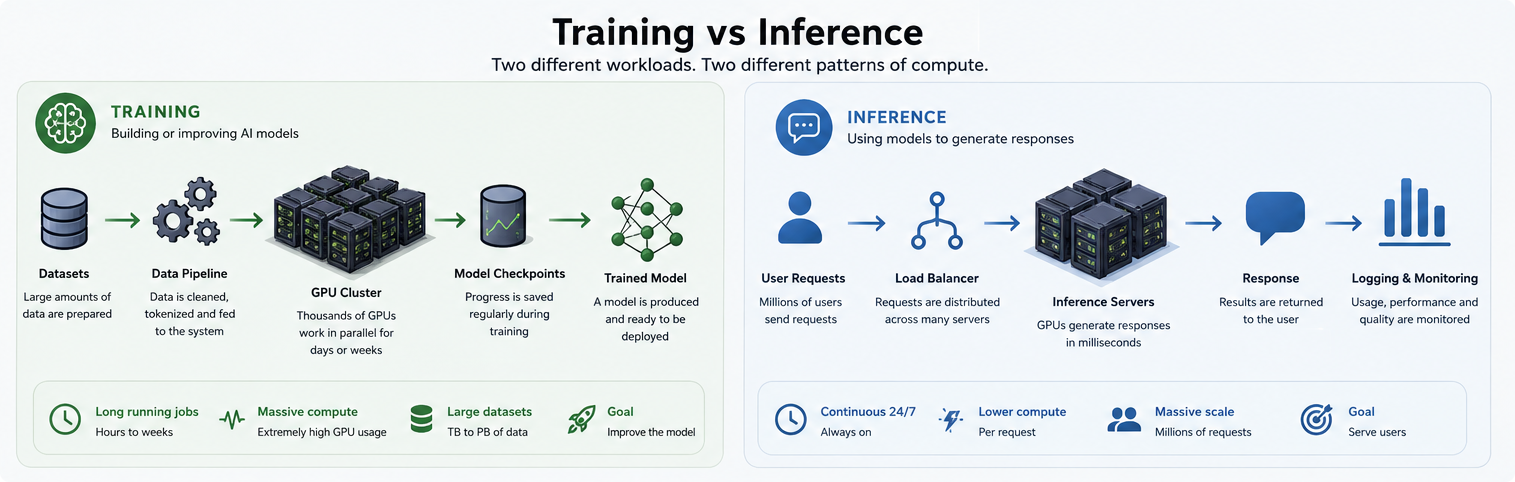
AI infrastructure supports two major categories of workloads: training and inference. Training involves building or updating AI models using extremely large datasets and computational resources.
Inference happens after training. It is the process where users interact with deployed AI systems such as chatbots, assistants, search systems, or image generators.
While training consumes massive bursts of computation, inference creates continuous demand because millions of users may interact with AI systems every day.
Electricity consumption
AI datacenters consume large amounts of electricity because GPUs operate continuously under heavy computational load. Large GPU clusters can require megawatts of power at scale.
Electricity is not only consumed by the GPUs themselves. Power is also required for networking equipment, storage systems, cooling infrastructure, backup systems, and facility operations.
As global AI adoption accelerates, electricity demand from AI infrastructure is becoming an important topic for energy providers, governments, and environmental researchers.
Cooling systems and water usage
Most electrical energy used by AI hardware eventually becomes heat. Removing this heat is critical to maintaining safe operating temperatures and reliable performance.
Many AI datacenters rely on advanced cooling systems using chilled water, evaporative cooling, or liquid cooling technologies. Water is often used because it transfers heat efficiently.
Cooling infrastructure has become one of the most important engineering challenges for modern AI facilities, especially as GPU density continues to increase.
Networking and storage
AI systems require extremely fast networking because GPUs constantly exchange enormous amounts of data during both training and inference.
Storage infrastructure is equally important. AI models, datasets, checkpoints, logs, and user interactions generate massive quantities of information that must be stored and transferred efficiently.
The combination of GPUs, networking, storage, and cooling systems creates highly specialized infrastructure unlike most traditional datacenters.
The future of AI infrastructure
AI infrastructure is expanding rapidly worldwide as companies race to deploy more capable models and services. New datacenters are being built specifically for AI workloads rather than traditional cloud computing.
Future AI datacenters may rely more heavily on liquid cooling, renewable electricity, optimized AI chips, and more efficient infrastructure designs.
As AI becomes integrated into more industries and services, understanding how AI infrastructure works will become increasingly important for technology, energy, and environmental discussions.