
Table of contents
What happens when you send an AI query?
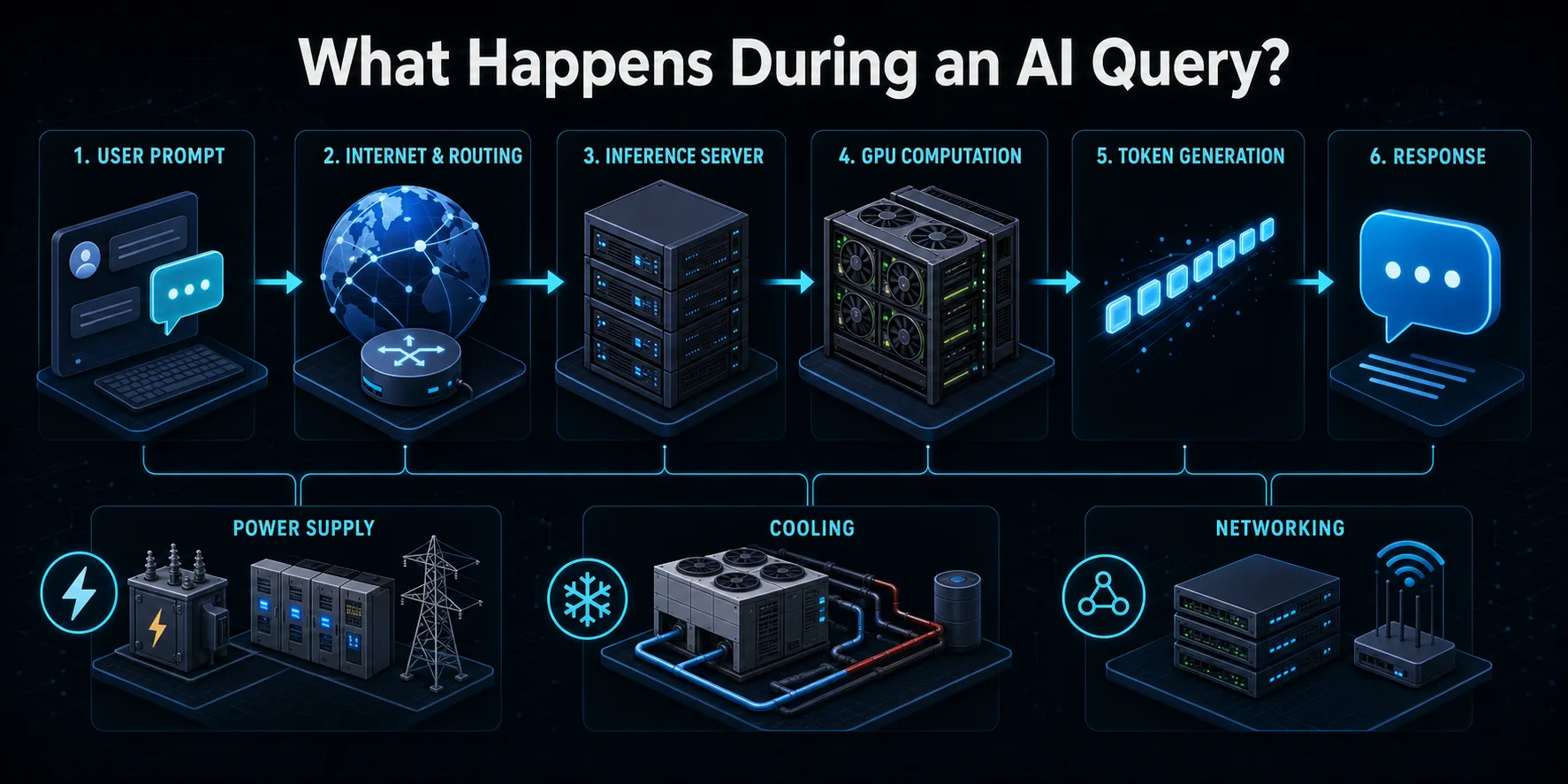
When you submit a prompt to an AI service, the request first travels across the internet to the provider's infrastructure. Routing systems authenticate the request, apply safety and usage controls, and direct it toward an available inference server. A load balancer may choose among many machines so that user traffic is distributed without overloading one part of the system.
The server converts the prompt into tokens, the numerical units processed by a language model. Those tokens and any previous conversation context are loaded into accelerator memory. GPUs or other AI chips then perform layers of matrix calculations across the model's parameters to predict the next token. The process repeats many times until the response is complete or reaches a configured limit.
The generated output is decoded into text and streamed back to the user, often while later tokens are still being calculated. Around this visible interaction, storage, networking, monitoring, power conversion and cooling equipment remain active. A query therefore uses more than the electricity measured at the GPU alone, even though the accelerator usually performs most of the intensive computation.
Why AI queries consume electricity
AI inference is an active computation rather than a simple retrieval from a database. A large model must evaluate many numerical operations for every generated token, using parameters that may occupy tens or hundreds of gigabytes of memory. Moving those parameters and intermediate values between high-bandwidth memory and processor cores consumes electricity alongside the calculations themselves.
The amount of work grows with the model, the prompt and the requested output. Long conversation histories require more context to be processed, while long answers keep the accelerators running for more generation steps. Image, audio and video systems can require different processing pipelines or repeated refinement operations, so an AI query is not one standardized unit of work.
Datacenter overhead also matters. Servers need power supplies, networking, storage and cooling, and some electricity is lost during power conversion and distribution. Operators often express this overhead through power usage effectiveness, or PUE. An efficient facility brings total energy closer to the energy used by computing equipment, while a less efficient facility requires more supporting electricity for the same inference workload.
How much electricity does an AI query use?
There is no universal electricity figure for an AI query. Public estimates for text interactions commonly range from fractions of a watt-hour to several watt-hours, but the range should be treated as an order of magnitude rather than a fixed conversion. A short request handled by an optimized, well-utilized model can use much less energy than a long response from a larger model running on underused hardware.
A watt-hour measures energy, not instantaneous power. For example, a server drawing high power for a fraction of a second may use less total energy than a lower-power system running for much longer. A credible per-query estimate therefore needs both the equipment's power draw and the duration and share of that equipment attributable to the request.
Comparisons with web searches, light bulbs or phone charging can make the scale easier to visualize, but they often hide important assumptions. The relevant question is not whether every prompt consumes one specific amount. It is which model served the request, how many tokens and modalities were processed, how efficiently requests were grouped, and how much infrastructure energy was included in the calculation.
Why estimates vary
AI providers rarely publish complete measurements that connect individual requests to model size, hardware utilization, token counts and facility overhead. Researchers must therefore combine disclosed hardware specifications, benchmark results, estimated serving times and datacenter efficiency assumptions. Different choices at any step can produce substantially different answers.
Batching is one major source of variation. An inference server can process several users together, sharing model loading and computation across a batch. High utilization can reduce the average energy assigned to each request, while idle capacity, latency requirements or traffic spikes can leave expensive hardware partially used. Newer accelerators may also complete the same workload faster or with fewer joules.
The boundary of the estimate changes the result as well. Some calculations count accelerator energy only; others include CPUs, memory, networking, cooling and power losses. Most per-query figures exclude the earlier energy used to manufacture hardware and train the model. Estimates are most useful when their system boundary and assumptions are explicit, not when a single number is presented as universal.
AI queries versus AI training
Training creates or updates a model by repeatedly processing large datasets and adjusting its parameters. A major training run can occupy thousands of accelerators for days or weeks, making it a concentrated and highly visible computing event. Once training is complete, the resulting model can be deployed across many inference servers to answer user requests.
Inference is usually much smaller for one interaction, but it is continuous. Production systems must respond at any hour, keep enough capacity available for peaks and serve users in multiple regions. The energy profile is therefore distributed across many datacenters and repeated every time text, images, audio or other outputs are generated.
Neither workload should automatically be assumed to dominate a model's lifetime electricity use. Training may be the largest single event, especially for frontier systems, while inference can eventually exceed it when a service handles enormous traffic over months or years. The balance depends on how often models are retrained, how widely they are deployed and how intensively people use them.
Billions of queries add up
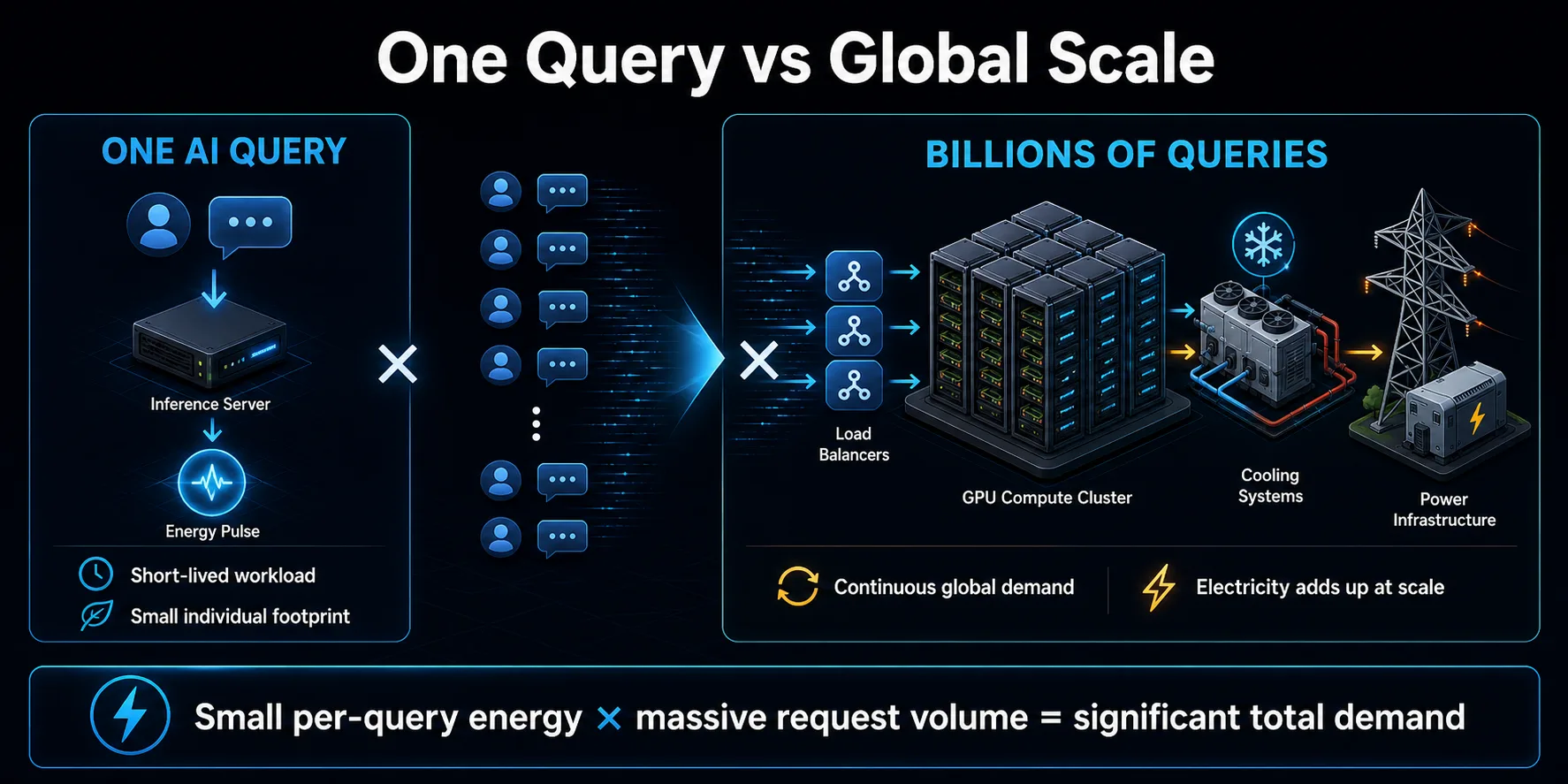
The environmental significance of AI queries comes primarily from multiplication. A single short prompt may represent a small amount of energy, yet consumer assistants, search features, coding tools and business applications can generate vast numbers of requests. Repeated continuously, modest per-request energy becomes a substantial datacenter load.
Demand is not limited to visible chatbot messages. Applications may make several model calls to answer one user action, use separate models for moderation or retrieval, retry failed requests, and generate background summaries or recommendations. Agentic systems can extend this pattern by calling models and software tools repeatedly while completing a single task.
Scale also affects infrastructure planning. Providers build capacity for growth and peak traffic, which can increase electricity demand before every server is fully utilized. The total impact depends on both efficiency per query and the rate at which usage expands. If demand grows faster than efficiency improves, aggregate electricity consumption can continue rising even while each individual interaction becomes less energy-intensive.
Will AI queries become more efficient?
AI inference is likely to become more energy-efficient at the level of a comparable task. New accelerators deliver more computation per unit of electricity, while quantization, pruning, speculative decoding and improved model architectures can reduce the operations needed for useful output. Better scheduling and batching can also raise hardware utilization without changing the user experience.
Smaller specialized models offer another path. A service does not always need its largest model for classification, extraction or routine questions. Routing simple work to compact models, limiting unnecessary context and caching reusable results can reduce both latency and electricity use. Datacenters can further improve total efficiency through power delivery, cooling and workload placement.
Efficiency does not guarantee lower overall consumption. Faster and cheaper AI can encourage more applications, longer interactions and new compute-intensive features, an effect sometimes described as rebound demand. The future electricity footprint of AI queries will therefore depend on two competing trends: how rapidly each unit of useful work becomes more efficient, and how quickly the total volume and complexity of AI use grows.