
Key takeaway
AI uses GPUs because modern neural networks perform huge numbers of parallel calculations. GPUs are designed to run many operations at once, making them essential for training and running large AI models.
Contents
Why CPUs are not enough for modern AI
Traditional CPUs are extremely versatile and excel at executing a wide variety of computing tasks. They are optimized for sequential operations, operating systems, business software, databases, and countless other workloads.
Artificial intelligence is different. AI needs GPUs because training and running modern models requires performing enormous numbers of mathematical operations simultaneously. This type of workload quickly overwhelms conventional processors.
While CPUs remain essential components of AI systems, they cannot efficiently provide the massive parallel processing capabilities required by today's largest models.
The power of parallel processing
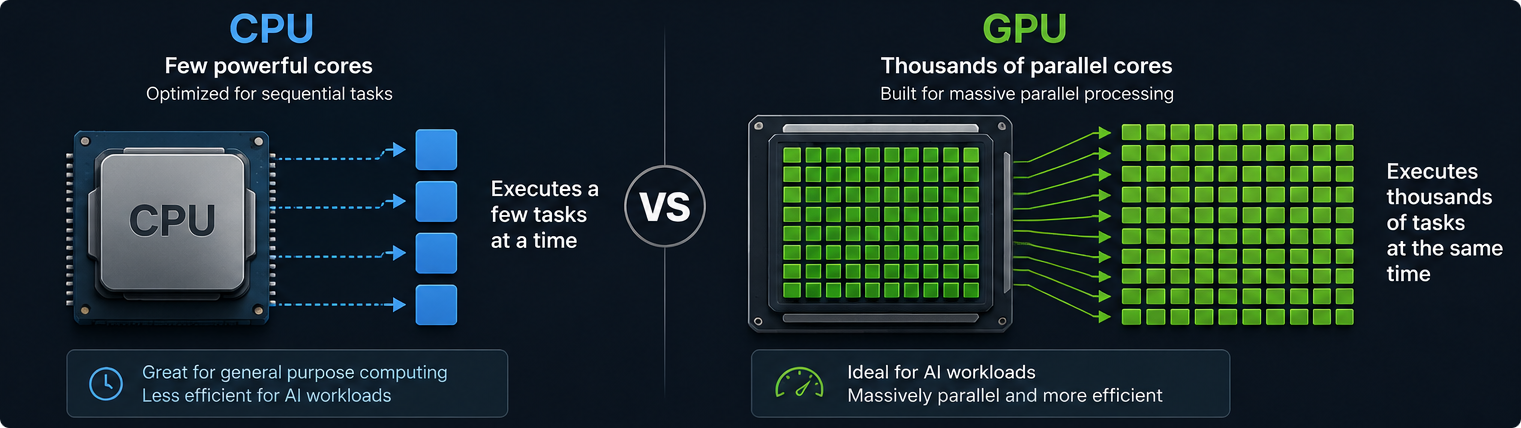
GPUs were originally developed to render computer graphics. Rendering images requires performing similar calculations on millions of pixels at the same time, making parallel processing essential.
AI workloads share many of these characteristics. Neural networks perform large matrix operations that can be split across thousands of processing cores simultaneously.
Because GPUs contain far more parallel execution units than CPUs, they can dramatically accelerate AI computations while improving overall efficiency.
Training large AI models
Training an AI model involves processing enormous datasets and adjusting billions or even trillions of parameters. This process requires extraordinary computational resources.
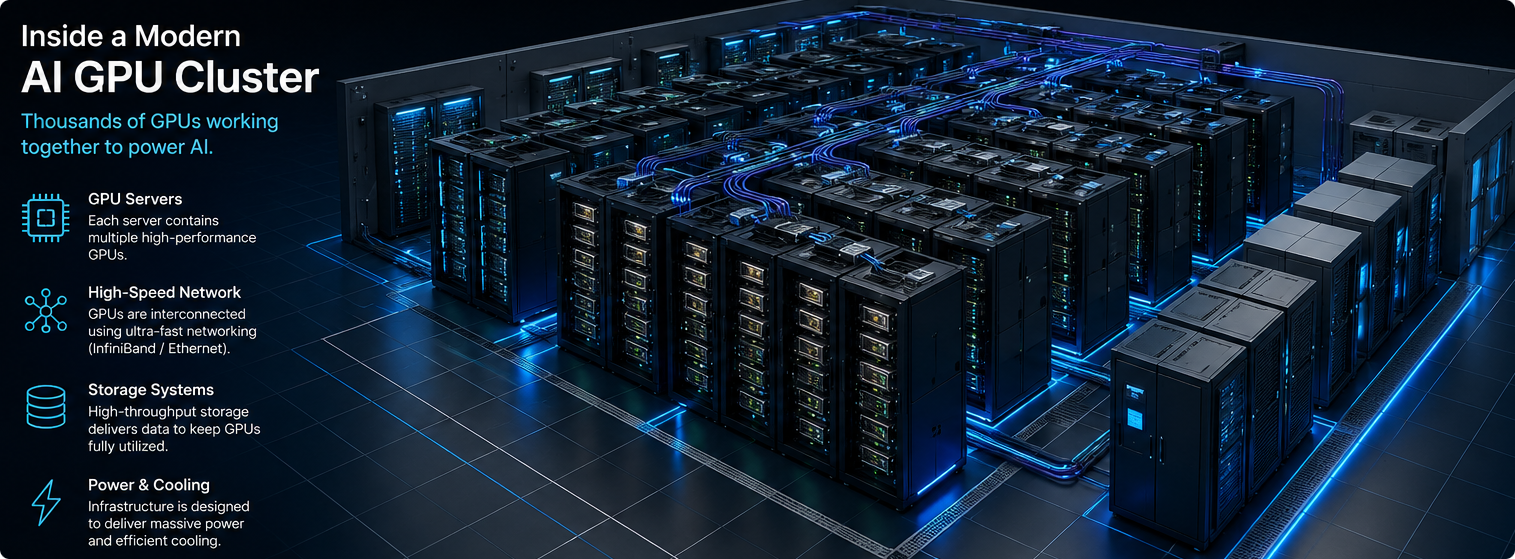
Large language models are typically trained using clusters composed of hundreds, thousands, or even tens of thousands of GPUs working together for weeks or months.
Without GPU acceleration, training many of today's most advanced AI models would be economically or technically impractical.
Inference also requires GPUs
Many people assume that GPUs are only required during training. In reality, inference also consumes significant computational resources.
Every time a user submits a prompt, generates an image, or interacts with an AI assistant, hardware must perform billions of calculations to produce a response.
As AI adoption grows, serving millions of simultaneous users often requires vast fleets of GPUs distributed across multiple datacenters.
Why companies deploy thousands of GPUs
Leading AI companies operate infrastructure at extraordinary scale. Large deployments frequently involve thousands of accelerators connected through ultra-fast networking technologies.
These clusters allow AI models to be trained faster, serve more users, and maintain acceptable response times under heavy demand.
The resulting infrastructure investments explain why GPUs have become one of the most strategic resources in the AI industry.
Will AI always need so many GPUs?
Future hardware will almost certainly become more efficient. Specialized AI accelerators, improved software optimization, and new chip architectures may reduce the amount of hardware required for a given workload.
At the same time, AI models continue to become larger and more capable. Growing demand may offset many efficiency gains achieved by future generations of hardware.
For the foreseeable future, GPUs and AI accelerators are likely to remain critical components of the global AI ecosystem.