
Contents
MCP means Model Context Protocol
MCP stands for Model Context Protocol. It is an open protocol designed to help AI applications connect to external systems through a common interface.
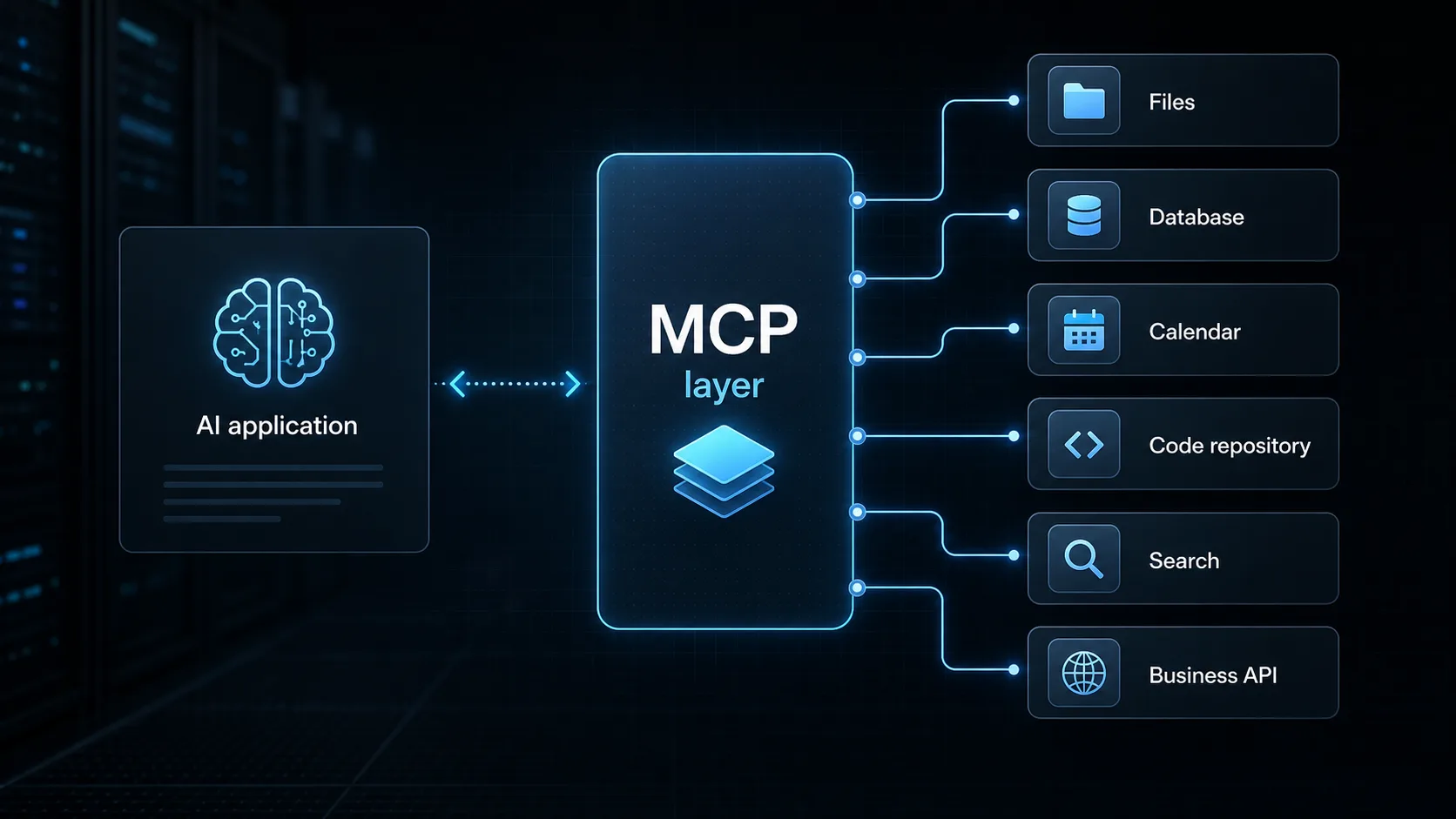
The problem MCP addresses is simple: useful AI assistants often need more than the model itself. They may need access to files, private databases, search tools, calendars, tickets, code repositories or internal business systems.
Without a shared protocol, every AI application and every tool can require a custom integration. MCP provides a more standardized way for applications to discover and use external context and capabilities.
Why AI assistants need external context
A language model can generate text from patterns learned during training, but it does not automatically know what is inside a user’s local files, a private company database or a live project management system.
That missing information is often the most important part of a real workflow. A useful assistant may need to read a document, inspect a codebase, retrieve a customer record, check a calendar, query a database or use a business API.
External context lets AI move from generic responses toward task-specific help. It also means integrations must be designed carefully, because the assistant may be working with sensitive data or systems that can take real actions.
How MCP works at a high level
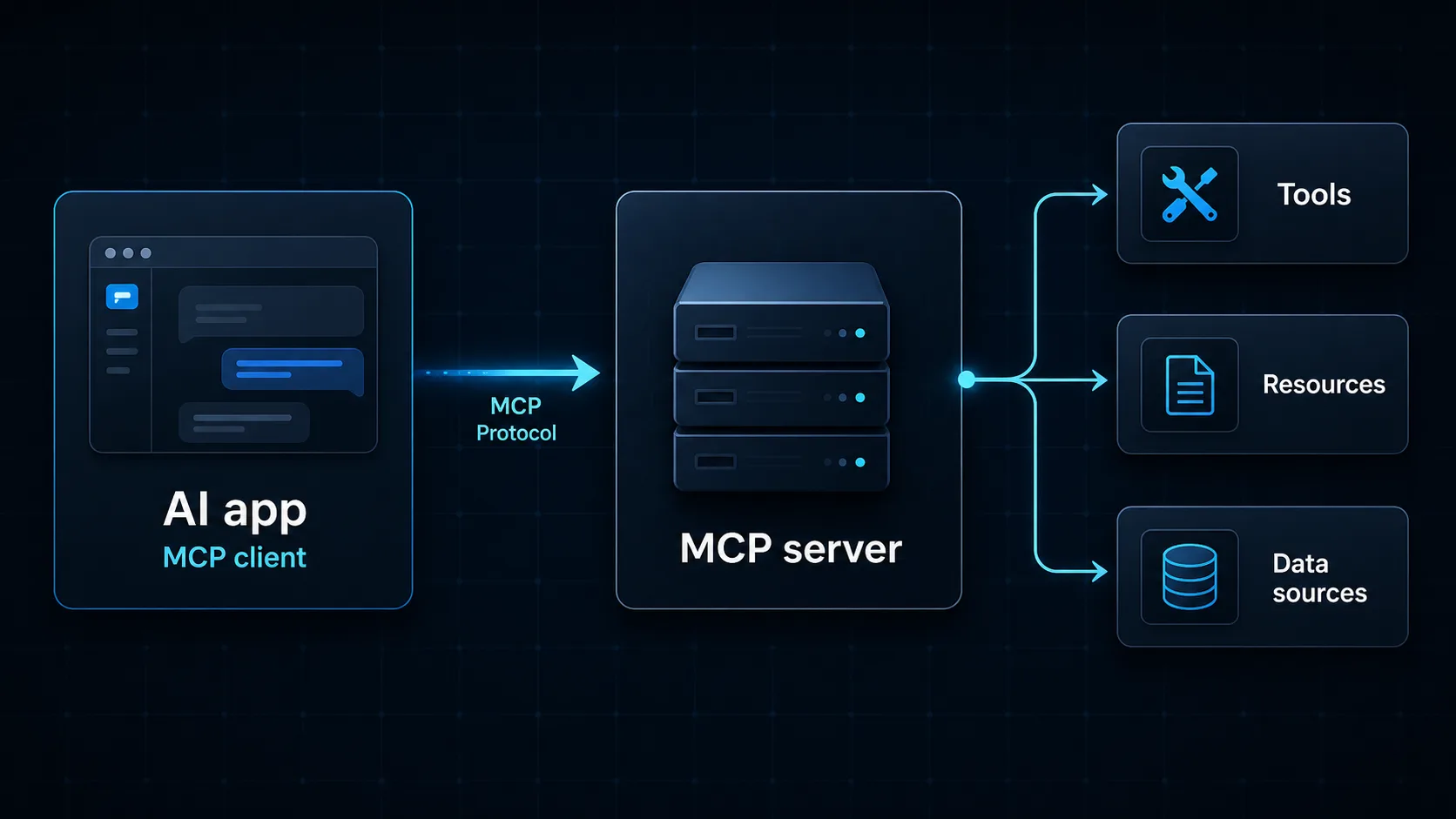
At a high level, MCP uses a client-server architecture. An AI application acts as a host, runs one or more MCP clients, and connects those clients to MCP servers.
An MCP server exposes capabilities such as tools, resources and prompts. Tools can perform actions, resources can provide context, and prompts can offer reusable interaction patterns for the AI application.
The details can vary by implementation, but the goal is consistent: give AI applications a structured way to discover what a connected system can provide and to request that capability through a defined protocol.
MCP versus traditional APIs
A traditional API connects software systems directly. Developers define endpoints, authentication, request formats and responses for a specific service or product.
MCP does not make APIs obsolete. In many cases an MCP server may use existing APIs behind the scenes. The difference is that MCP gives AI applications a more standard way to expose and consume tool-like capabilities.
That distinction matters because AI assistants may need to work across many tools. A protocol designed for AI context and tool use can reduce repeated integration work, but it does not remove the need for careful API design and security.
Why MCP matters for AI agents
AI agents are most useful when they can use tools, gather context, execute steps and update their plan based on results. MCP helps create a common integration layer for those tool interactions.
For example, an assistant might read a file, search documentation, inspect a database record and then call a business system. MCP gives developers a clearer pattern for making those capabilities available to the AI application.
This does not mean every agent needs MCP or that MCP guarantees reliable behavior. It means MCP is one important approach to making tool access more consistent as AI workflows become more complex.
Security, permissions and reliability
Connecting AI assistants to tools creates real security questions. A tool may read private data, modify files, send messages, create tickets, query systems or trigger actions with operational consequences.
That is why MCP integrations still need permissions, user approval flows, input validation, output validation, logging and auditability. The protocol can structure the connection, but it does not remove the need for application-level guardrails.
Reliable AI tool use also depends on clear tool descriptions, predictable schemas, error handling and conservative defaults. The safer pattern is to make powerful actions explicit, reviewable and limited to the permissions the user actually granted.
The future of AI tools and protocols
As AI assistants become more capable, they will need better ways to connect with the tools and data people already use. Integration standards are likely to matter more as workflows move beyond a single chat window.
MCP is an important signal in that direction because it treats tool and context access as a shared protocol problem, not only as a collection of one-off integrations.
The ecosystem will continue to evolve. MCP may become part of a broader set of patterns for AI agents, APIs, permissions and workflow automation rather than a single universal answer to every integration problem.