
Contents
AI models turn inputs into outputs
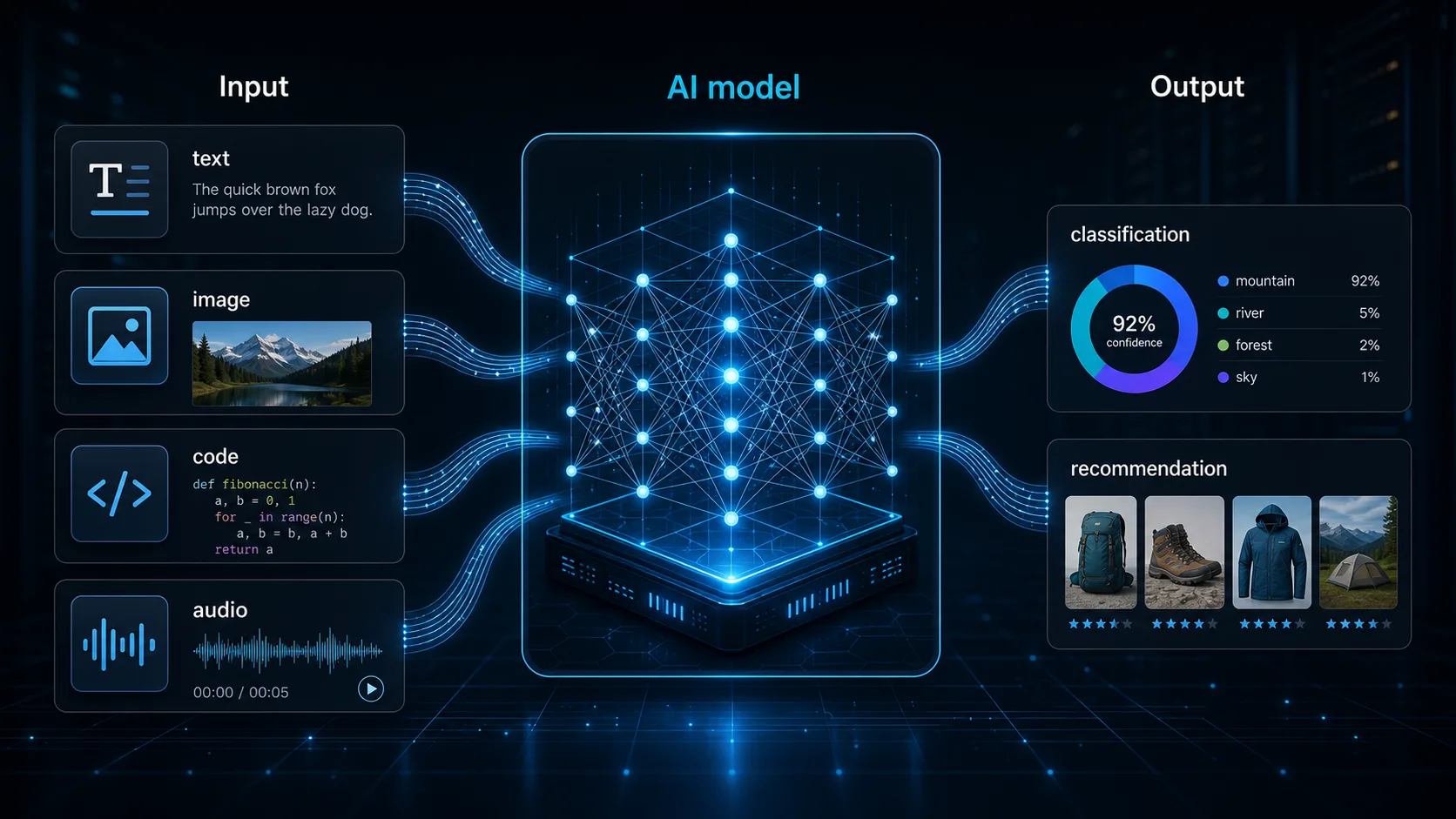
At the simplest level, an AI model is a system that receives an input, processes it through learned internal patterns, and produces an output. The input might be a sentence, an image, a sound clip, a line of code, a table row or a user prompt.
The output depends on the task. A model may predict the next word in a sentence, classify an image, recommend a product, summarize a document, translate text, write code, identify speech or generate a new image. The same general idea appears across many AI systems: input, model, output.
This does not mean the model understands the world in the same way a person does. It means the model has learned useful statistical relationships from examples and can apply those relationships to new inputs.
Models learn patterns during training
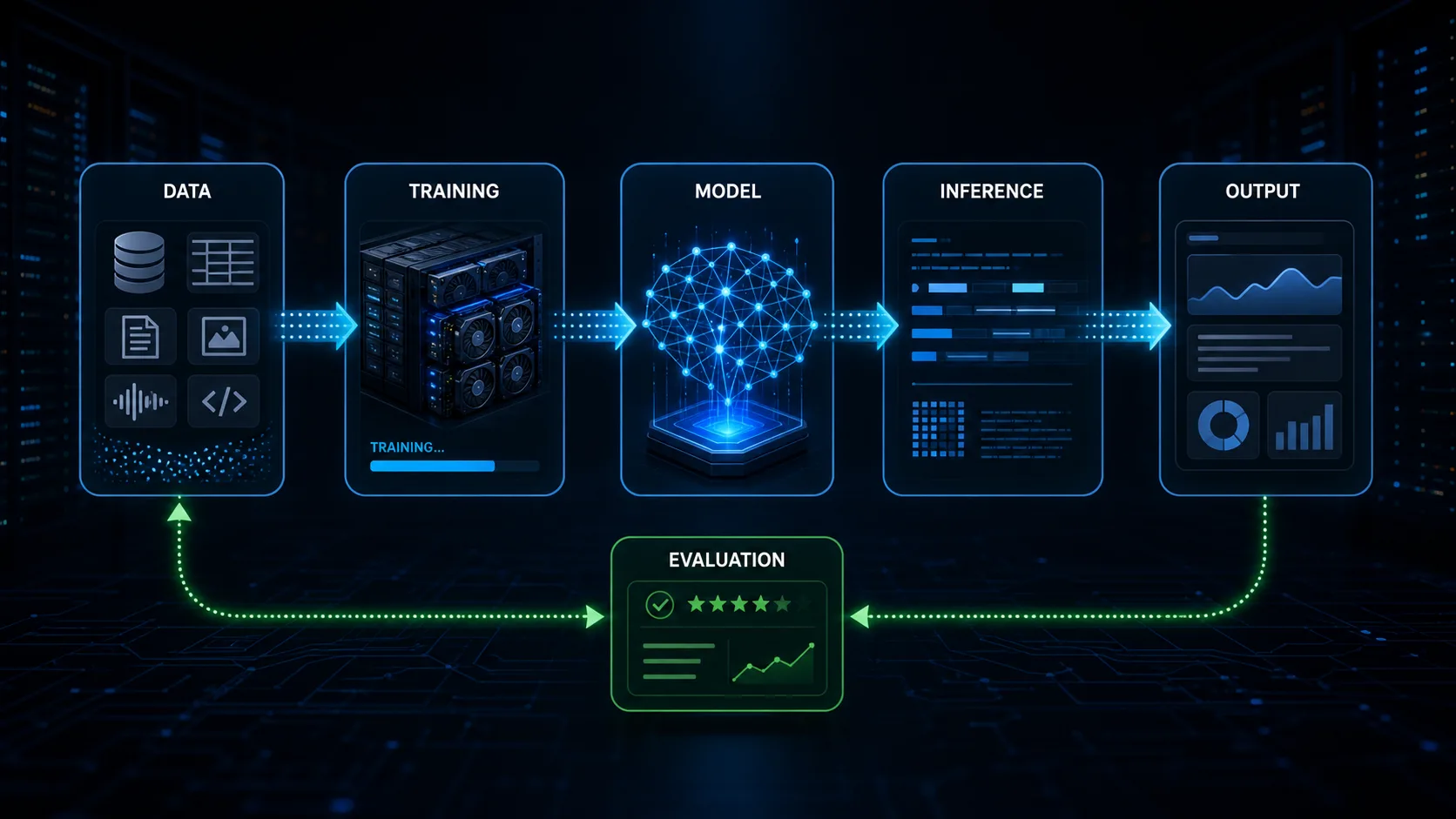
Before an AI model can be useful, it has to be trained. Training means showing the model many examples and adjusting it repeatedly so its outputs become closer to the desired result.
A language model may be trained on large collections of text and code. An image model may be trained on images and captions. A speech model may be trained on audio and transcripts. Across these examples, the model learns relationships between inputs and outputs rather than simply storing a list of answers.
This distinction matters. A trained model is not just a searchable database. It can generalize from training data to new situations, but that generalization is imperfect and depends heavily on the quality, diversity and structure of the data used during training.
Parameters store what the model has learned
The knowledge inside an AI model is represented through parameters. Parameters are internal numerical values that are adjusted during training. They shape how the model transforms an input into an output.
You do not need the mathematics to understand the idea. A parameter is like a tiny setting inside a very large system. Training changes many of these settings so the model becomes better at predicting, classifying or generating useful results.
Large AI models may contain billions or even trillions of parameters. More parameters do not automatically make a model better, but they can give a model more capacity to represent complex patterns when paired with strong data, training methods and evaluation.
Inference is when the model is used
After training, the model can be deployed. Inference is the phase where the trained model receives a new input and produces an answer, prediction or generated output.
Every ChatGPT response, AI image generation, recommendation result, search assistant answer or voice transcription requires inference. The model is not being fully retrained each time. It is applying what it already learned to the new request.
Inference still requires compute. Large models may need GPUs or other AI accelerators to answer quickly, especially when millions of users are sending prompts at the same time.
Why AI models sometimes make mistakes
AI models can make mistakes because they work from learned patterns, not guaranteed truth. If the training data is incomplete, biased, outdated or ambiguous, the model may produce an answer that sounds plausible but is wrong.
Language models can hallucinate when they generate fluent text without a reliable factual basis. Classification models can fail on examples that look different from their training data. Recommendation systems can amplify patterns that are present in past behavior but not actually useful for every user.
These problems do not make AI useless, but they do explain why evaluation, human review, grounding, retrieval, safety testing and clear product boundaries matter. A useful model is not only powerful; it is also tested for the context where it will be used.
Different models work in different ways
Not every AI model is a chatbot. Language models work with text and code. Image models generate or classify visual content. Embedding models convert text, images or other data into numerical representations that can be searched or compared.
Classification models assign labels. Recommendation models rank options. Multimodal models combine text, images, audio or video. Specialized models may be tuned for medicine, finance, robotics, translation, industrial inspection or customer support.
The architecture and training objective affect what the model is good at. This is why the AI ecosystem contains many different models rather than one universal system that is best for every task.
Why understanding AI models matters
Understanding how AI models work makes it easier to understand the infrastructure behind them. Training large models requires datasets, GPUs, datacenters, power, cooling and evaluation. Running models for users requires inference infrastructure that can respond quickly and reliably.
It also helps explain why data quality, model design and deployment choices matter. A smaller specialized model may be cheaper and more reliable than a very large general model for a narrow task. A poorly evaluated model can create risk even if it looks impressive in demos.
The practical question is not only whether a model can generate an answer. It is whether the answer is useful, reliable, efficient and appropriate for the task. That is why models, training, inference, GPUs and datacenters are all part of the same AI infrastructure story.