
Contents
The short answer: it depends on the design, location and energy source
AI datacenters can create real environmental pressure, but it is too simple to say that every AI datacenter is automatically bad for the environment. The same workload can have very different impacts depending on the electricity grid, cooling system, local water conditions and hardware efficiency.
A datacenter powered mostly by low-carbon electricity, using efficient cooling and transparent reporting, has a different footprint from one that relies on a fossil-heavy grid, consumes scarce local water or adds stress to an already constrained power system.
The useful question is not whether AI datacenters are good or bad in the abstract. It is what they consume, where they are located, what they replace or enable, and whether local communities can see the trade-offs clearly.
Electricity demand is the first environmental issue
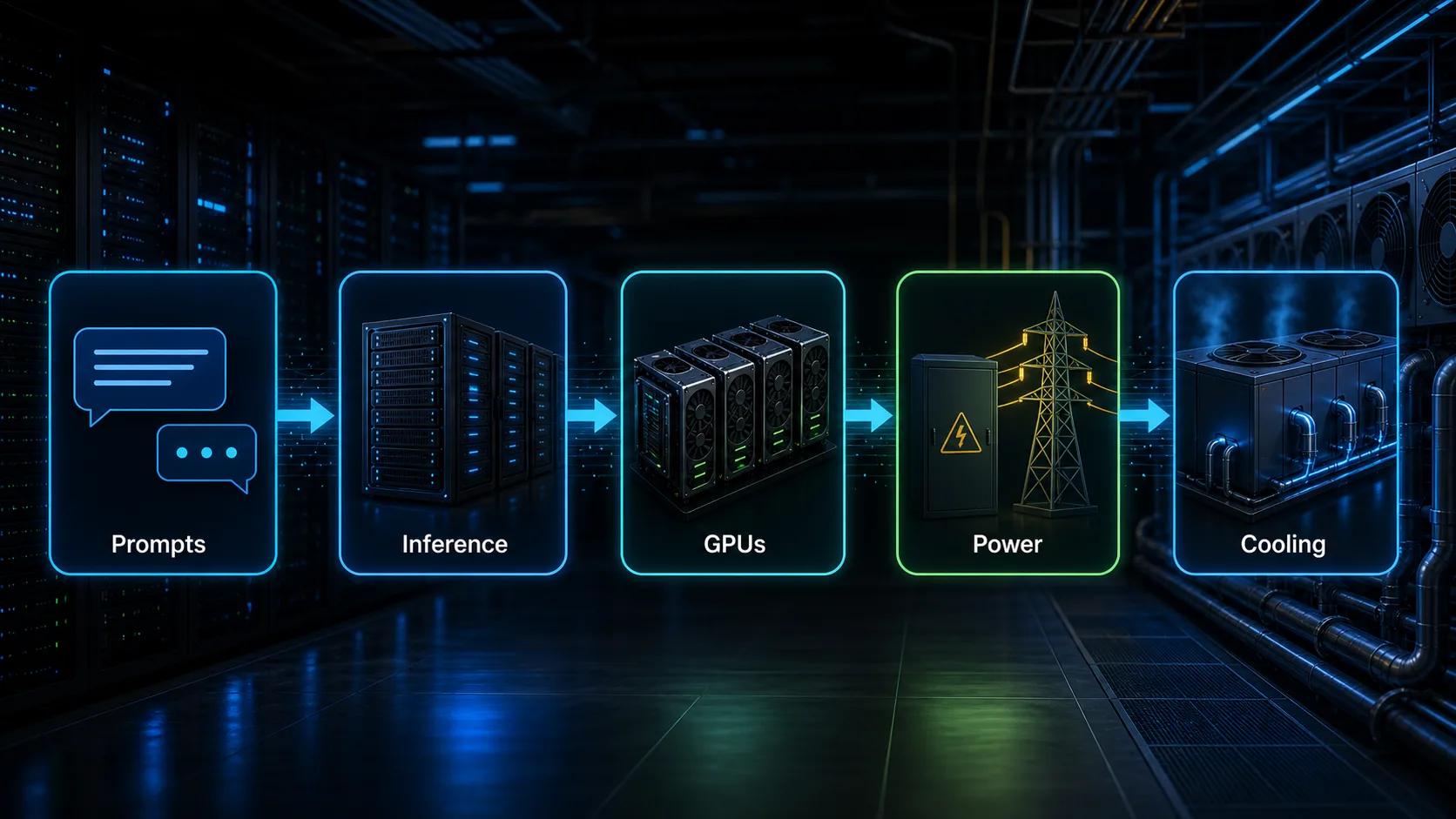
AI datacenters exist to run computation. Large AI systems rely on dense racks of GPUs, high-bandwidth networking, storage, memory and power delivery equipment. When these systems train models or serve inference requests, they consume electricity continuously.
The environmental impact of that electricity depends heavily on the grid. A megawatt-hour from a low-carbon grid has a different climate impact from a megawatt-hour generated mostly from coal or gas. This is why location matters as much as the hardware inside the building.
For a deeper explanation of why AI uses so much energy, see Why Does AI Use So Much Energy?.
Water use depends on cooling choices and local scarcity
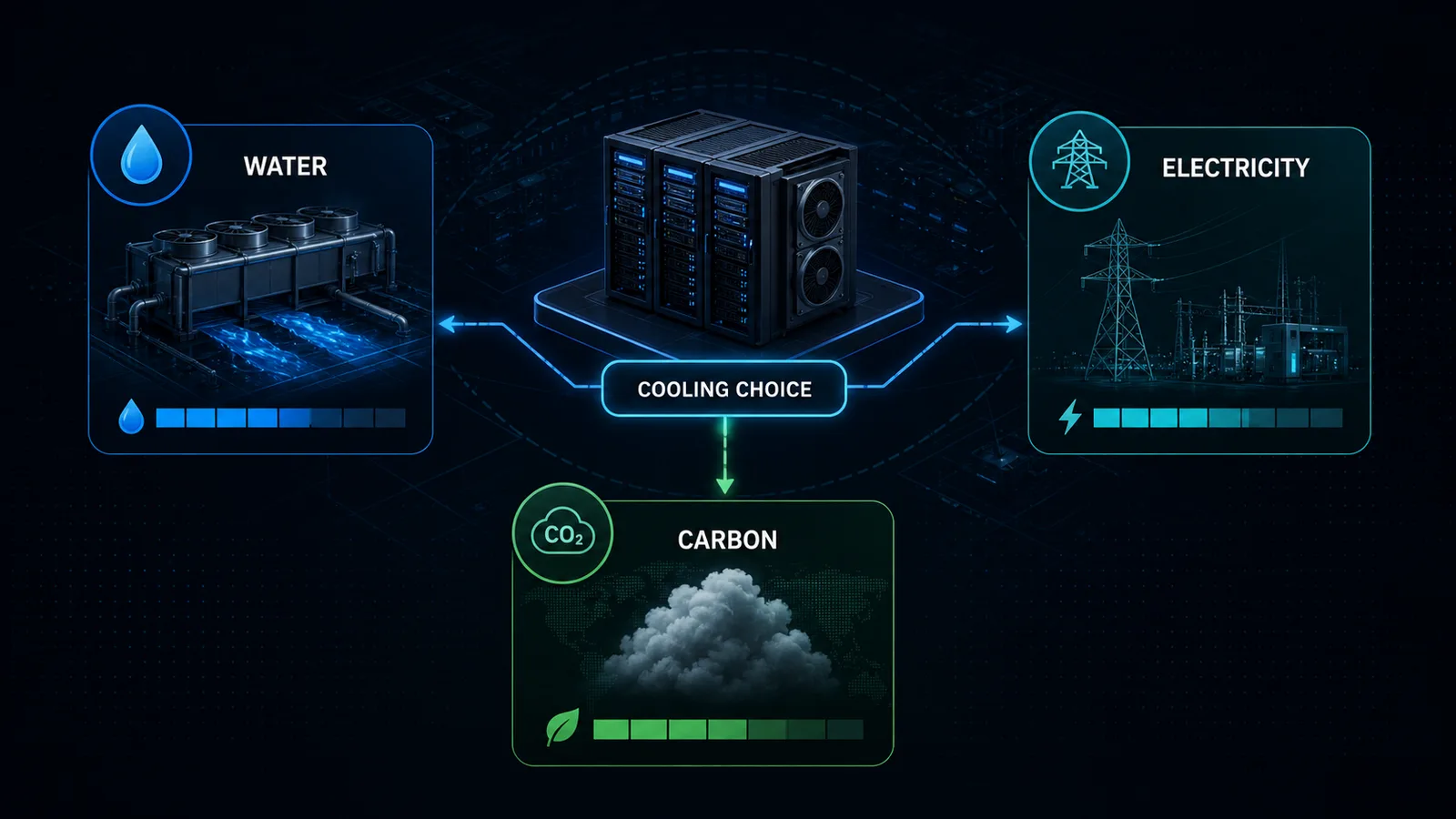
AI chips generate heat. Datacenters must remove that heat to keep servers reliable and efficient. Some facilities use air cooling, some use chilled water loops, some use evaporative cooling, and many use hybrid designs that change with outdoor conditions.
Water-based cooling can reduce electricity demand in some conditions, but it can also increase local water consumption. That trade-off is not automatically good or bad. It depends on the local climate, water stress, energy mix and whether the water is potable, reclaimed or otherwise managed.
For more detail on cooling and water use, see Why Do AI Datacenters Use So Much Water?.
Carbon emissions depend on the electricity mix
Most AI datacenter carbon emissions are indirect. The servers do not usually emit CO2 at the facility, but the electricity used to power them may come from fossil fuels somewhere on the grid.
This means the same AI model can have different carbon footprints depending on when and where it runs. Regional grid intensity, renewable procurement, backup generation and hourly electricity matching can all affect the real footprint.
Because detailed AI-specific energy sourcing is rarely public, carbon estimates should be treated as directional. Transparent assumptions are more credible than pretending that exact global totals are known.
Local impacts can matter as much as global totals
Datacenters are physical industrial facilities. They need land, grid connections, substations, fiber, backup systems, construction materials and cooling infrastructure. Even when global emissions are the headline issue, local effects can shape whether a project is accepted.
Communities may worry about water use, electricity bills, grid congestion, noise, tax incentives, land use, construction disruption or whether promised jobs match the scale of public support. These concerns are not identical everywhere.
That is why a serious environmental assessment should look beyond aggregate AI demand. It should ask what a specific datacenter does to a specific grid, watershed and community.
An emerging impact: semiconductor chemicals and PFAS
AI infrastructure also has an upstream material footprint. PFAS are used in parts of semiconductor manufacturing, including photolithography, etching, wafer processing and some heat-transfer applications. Expanding demand for advanced chips can therefore increase attention on chemical use, wastewater and the availability of safer substitutes.
The AI-specific scale remains uncertain. Not every liquid-cooling system uses PFAS, and public data do not support a precise global total attributable to AI alone. PFAS should therefore be treated as an emerging supply-chain issue rather than added directly to current AI impact meters.
The biggest problem is often incomplete transparency
Public reporting about AI infrastructure is improving, but it is still incomplete. Many companies disclose corporate energy or water figures, yet not always the details needed to isolate AI workloads, individual facilities or specific model-serving systems.
Without clear disclosure, outside estimates must combine public reports, infrastructure assumptions, hardware specifications and research. That can produce useful orders of magnitude, but it should not be confused with audited facility-level measurement.
Better transparency would make the debate more practical: how much electricity is needed, what grid resources are used, how cooling works, what water source is involved and how impacts change over time.
AI datacenters can improve, but demand may grow faster
The environmental footprint of AI datacenters can improve through more efficient chips, better model serving, smaller specialized models, heat reuse, improved cooling, better siting, lower-carbon electricity and stronger reporting standards.
Efficiency alone does not guarantee lower total impact. If AI usage grows faster than efficiency improves, total electricity demand, cooling needs and infrastructure build-out can still increase.
The realistic conclusion is nuanced: AI datacenters are not inherently bad, but they are not impact-free. Their environmental performance depends on engineering choices, local resource constraints, public accountability and the scale of demand they are built to serve.
Further reading and references
- International Energy Agency — Energy demand from AI
- Google Data Centers — Operating sustainably
- Google Data Centers — Responsible water use
- Microsoft Environmental Sustainability Report
- Uptime Institute — Global Data Center Survey 2025
- US EPA — Semiconductor manufacturing and PFAS
- Semiconductor Industry Association — PFAS Consortium
- Nebraska Data Center 2026 Annual Report — Agate LLC
- 10/11 NOW — Lincoln datacenter resource reporting