
Contents
An AI data center is where AI runs
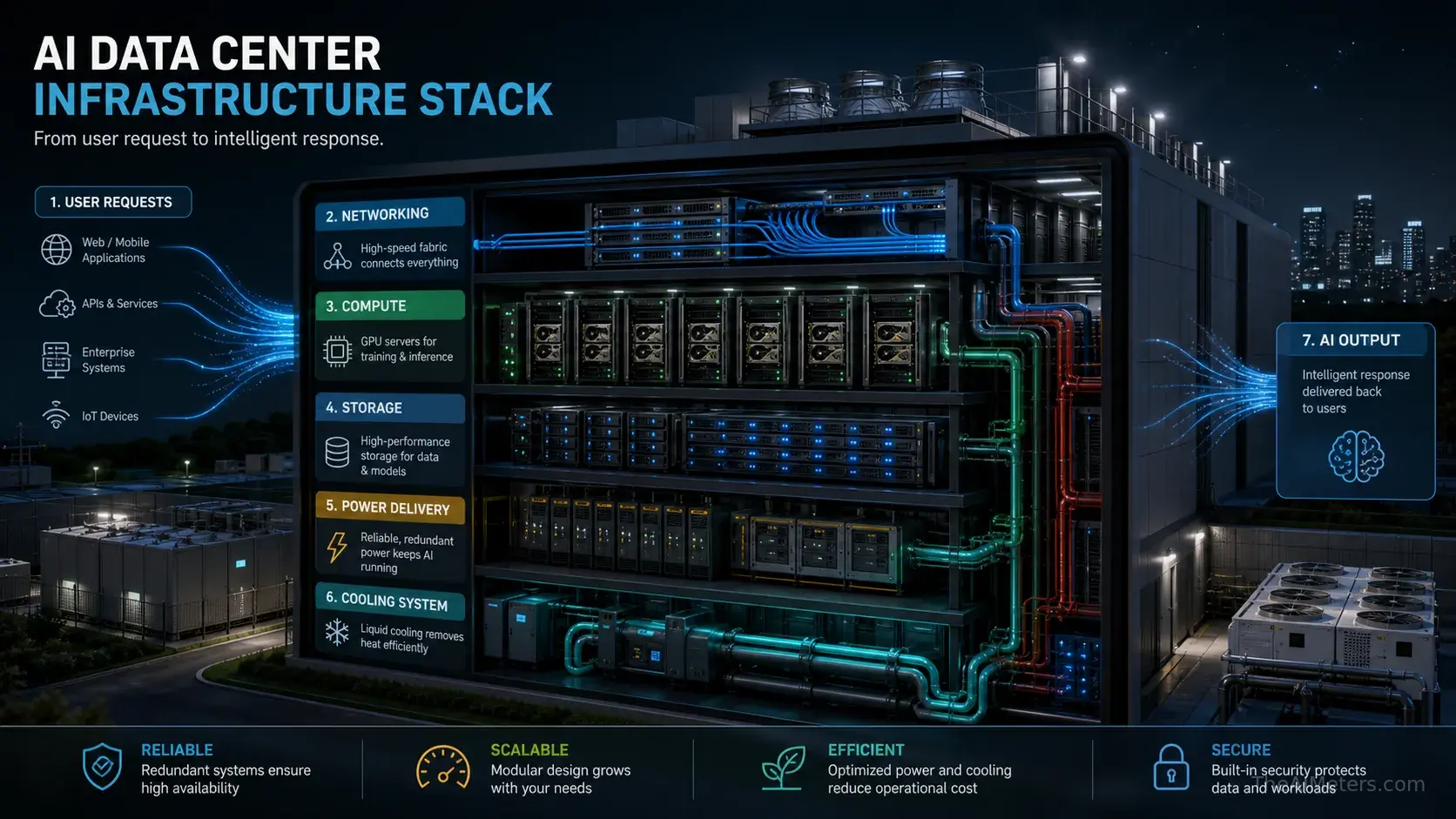
An AI data center is a specialized facility that houses the computing equipment needed to build, deploy and operate artificial intelligence systems. It may support model training, inference, data processing, search assistants, image generation, recommendation systems or enterprise AI applications.
The word data center can make the infrastructure sound abstract, but these are physical buildings connected to power grids, fiber networks, cooling systems and water or heat rejection infrastructure. AI may feel like software, but it depends on real machines in real places.
A conventional cloud data center can run many kinds of workloads. An AI data center is usually optimized for very dense computation, especially GPU or accelerator clusters that perform huge numbers of parallel mathematical operations.
What is inside an AI data center?
The visible core is racks of servers. In AI facilities, many of those servers contain GPUs, AI accelerators, high-bandwidth memory and specialized networking cards. These machines are designed to move data quickly and perform matrix calculations efficiently.
Around the compute hardware is a larger support system: storage for datasets and model checkpoints, network switches, fiber connections, power conversion equipment, backup systems, monitoring, fire suppression and physical security.
Cooling is just as important as computation. Dense AI hardware produces heat continuously, so facilities use air cooling, liquid cooling, chillers, pumps, cooling towers or heat exchangers depending on the design and local conditions.
What makes an AI data center different?
The main difference is density and workload shape. AI training can keep thousands of accelerators busy for long periods, while inference systems must respond quickly to user prompts, API calls, recommendations or generated images.
AI clusters also need extremely fast communication between machines. During training, GPUs exchange gradients and model data constantly. During inference, servers must load model weights, process context and return outputs with low latency.
This combination of dense chips, high power draw, fast networking and heat management makes AI infrastructure more demanding than many traditional web or enterprise workloads.
AI data centers support training and inference
Training is the phase where a model learns from data. It can require large datasets, long runs, repeated calculations and clusters of GPUs working together. This is often the most visible kind of AI compute because it produces large, concentrated infrastructure demand.
Inference is the phase where a trained model is used. Every chatbot answer, image generation, search assistant response or classification request runs inference. One request may be small, but global usage creates continuous demand.
Many AI data centers support both phases, though not always in the same way. Training cares about large synchronized clusters, while inference cares heavily about latency, availability, routing, batching and cost per request.
Power and cooling shape every AI data center
AI hardware needs electricity, and almost all of that electricity eventually becomes heat. A facility therefore needs enough power delivery to run the equipment and enough cooling capacity to remove heat reliably.
That is why AI data centers are often discussed in megawatts or gigawatts, not only in square meters. The limiting factor may be grid connection, transformers, backup generation, cooling water, heat rejection or local permits rather than land alone.
Better chips, liquid cooling and more efficient data center design can reduce energy per task, but total demand can still grow if AI usage expands faster than efficiency improves.
Where are AI data centers built?
AI data centers are built where operators can combine power, land, fiber connectivity, cooling options, tax and permitting conditions, workforce availability and proximity to users or cloud regions.
Some locations are publicly identified as AI supercomputer or AI infrastructure sites. Others are general hyperscale cloud regions that can run AI workloads but are not publicly tied to one specific model or product.
For a cautious public overview, see the companion listing: Where Are AI Data Centers Located?.
Why AI data centers matter
AI data centers matter because they connect everyday AI use to physical infrastructure. A prompt on a laptop or phone may trigger computation inside GPU servers, which depend on electricity, cooling, water, chips, land and networks.
They also matter for local communities. Large facilities can bring investment and jobs, but they can raise questions about grid capacity, water use, land use, noise, emissions, transparency and who pays for supporting infrastructure.
A serious discussion of AI impact therefore has to look beyond abstract model capability. It has to include where the infrastructure runs, how it is powered, how efficiently it is cooled and how openly its operators report resource use.