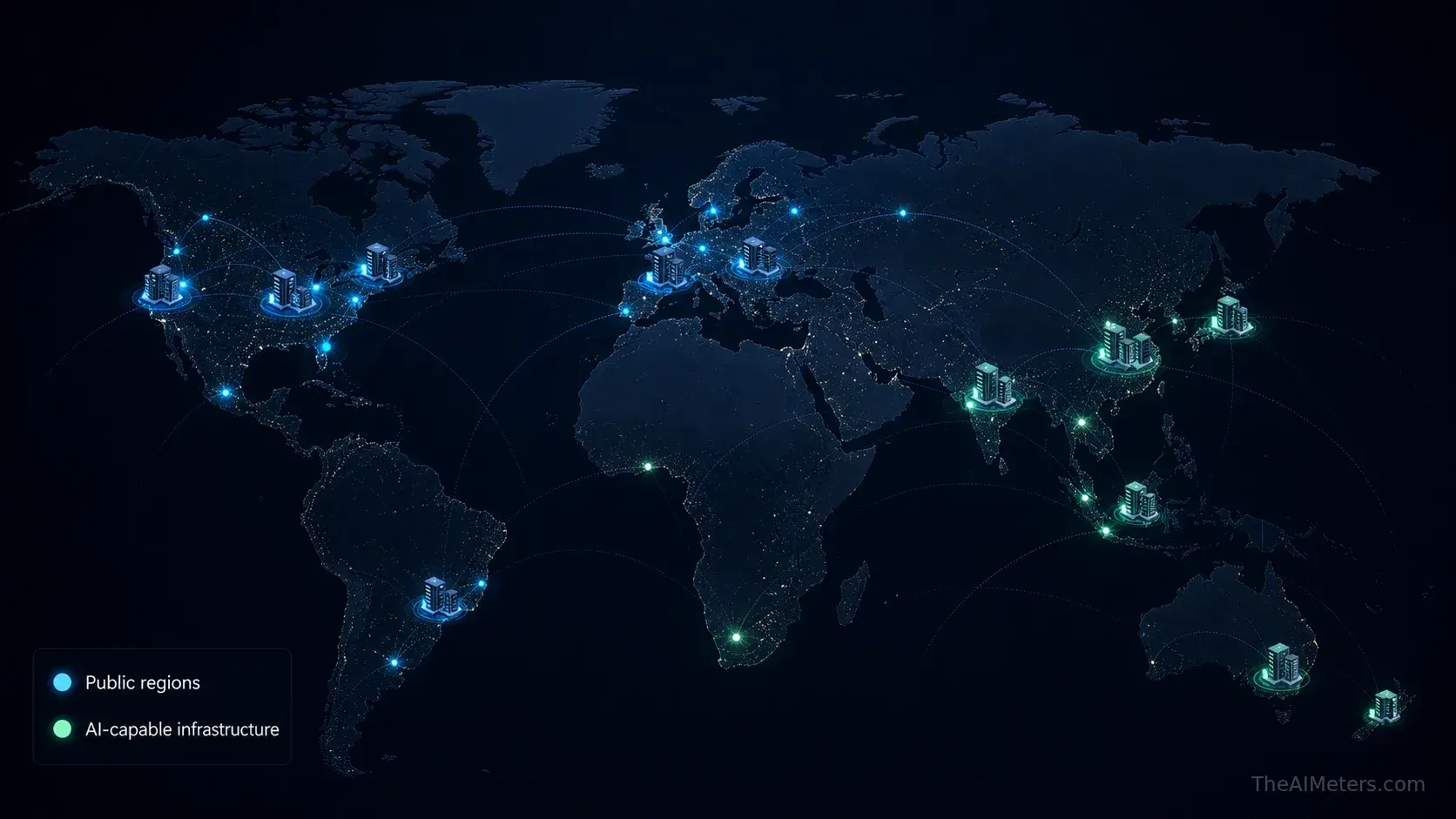
AI data centers are not distributed randomly. They tend to cluster near power capacity, fiber networks, available land, cloud regions, cooling options, skilled labor and permitting environments that can support large infrastructure projects.
Some locations are publicly announced as AI facilities, such as large supercomputer sites or Stargate campuses across several U.S. states. Many others are hyperscale cloud regions that can run AI workloads but do not disclose which models or products run inside each building.
This page is therefore a public, partial map of major regions and examples. It avoids exact street-level mapping and does not claim to identify every facility; even large public datasets can count facilities without showing their size, AI workload share or utilization.
How to read this map
The entries below are selected from official operator pages, cloud infrastructure documentation, public announcements, open data center mapping resources and independent research such as the Stanford AI Index. A region can appear because it is an explicit AI site, a public hyperscale data center campus, an announced AI infrastructure buildout or a major cloud region that supports AI-capable infrastructure.
The list is intentionally conservative. It should be read as a practical guide to public signals, not a complete inventory or a security-sensitive facility directory. For example, the Stanford AI Index cites Cloudscene data showing the United States far ahead in public data center counts, while also warning that counts do not capture facility size, compute capacity or utilization.
Major public AI and hyperscale data center regions
Selected examples based on public sources. Categories describe why the region is relevant; they do not mean every facility in the region is dedicated to AI.
Hyperscale region
Northern Virginia, United States
One of the largest cloud and data center regions in the world, represented publicly through AWS, Azure and public U.S. data center mapping resources.
AWS Global InfrastructureCloud and hyperscale region
Oregon and Pacific Northwest, United States
A major western U.S. infrastructure region, including public cloud regions and large campuses such as Google The Dalles and Meta Prineville.
Google Data Center LocationsAI infrastructure buildout
U.S. Stargate buildout: Texas, New Mexico, Ohio, Wisconsin and Michigan
OpenAI’s public Stargate announcements identify AI campuses and sites across Texas, New Mexico, Ohio, Wisconsin and Michigan. Some are operating or partially operating, while others remain under development or expansion.
OpenAI Stargate communityExplicit AI supercomputer site
Memphis, Tennessee, United States
Memphis is publicly identified by xAI as the home of Colossus, a large AI supercomputer facility used for Grok.
SpaceXAI MemphisEuropean cloud and data center regions
Ireland, the Netherlands, Germany, Belgium and the United Kingdom
Ireland, the Netherlands, Germany, Belgium and the United Kingdom appear in public hyperscale data center fleets and cloud regions, including operating and announced locations.
Google Data Center LocationsCool-climate infrastructure region
Nordics: Denmark, Sweden and Finland
Nordic locations appear in public data center fleets because cool climates, power access and network connectivity can support large-scale infrastructure.
Google Data Center LocationsAsia-Pacific cloud region
Singapore and Southeast Asia
Singapore is a publicly listed data center location and a dense regional cloud hub for Asia-Pacific workloads.
Meta global data centersAsia-Pacific AI-capable infrastructure
Japan, Taiwan, India, Malaysia and Thailand
Japan, Taiwan, Singapore, India, Malaysia and Thailand appear in public cloud and data center location pages, with a mix of operating and in-development facilities.
Google Data Center LocationsWhy the full list is not public
Operators often publish cloud regions, data center campuses or investment announcements, but they do not usually publish the exact workloads running in every building. One facility may support search, storage, enterprise cloud, AI inference and internal systems at the same time.
Some sites are leased from colocation providers, some are under construction, and some are announced before final capacity, power agreements or permitting details are complete. Public records can also lag behind construction or operational changes.
For that reason, a responsible AI data center map should use broad regions, clear source labels and uncertainty language. It should not imply that every visible cloud location is an exclusive AI facility, or that a public facility count is the same thing as AI compute capacity.