
Contents
What AI robotics means
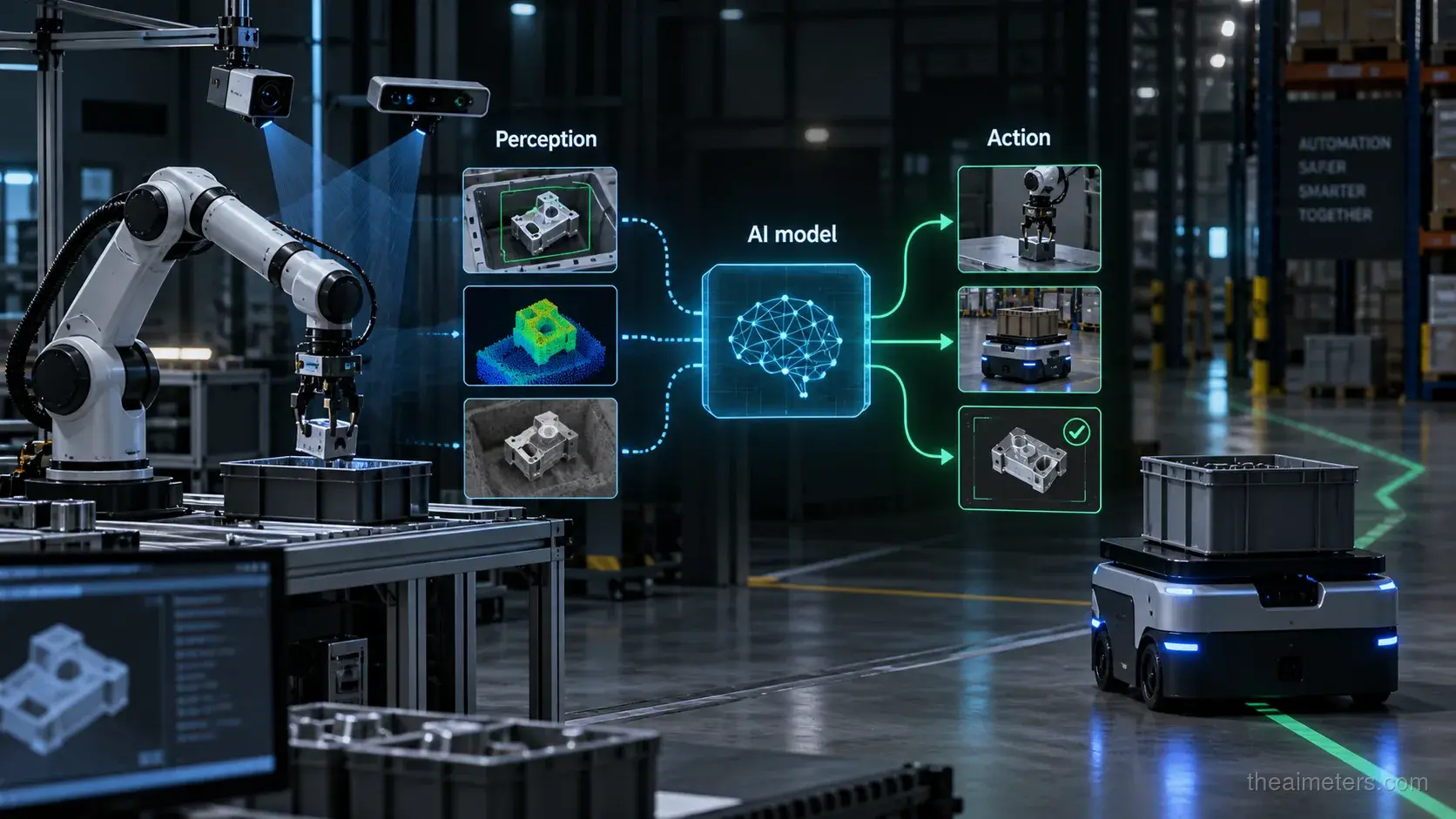
AI robotics, sometimes called physical AI or embodied AI, is the use of artificial intelligence to help machines operate in the physical world. Instead of only generating text or images, the system has to connect perception, reasoning and action.
A robot may use cameras, depth sensors, force sensors, microphones or position sensors to understand what is around it. AI models can help interpret those signals, identify objects, follow instructions, plan a path, choose a grasp or decide when an action is unsafe.
This does not mean every robot is a general-purpose humanoid. Most useful robots today are still specialized: factory arms, warehouse robots, inspection systems, surgical tools, drones, autonomous vehicles, delivery robots or service machines. AI expands what they can perceive and adapt to, but the hardware and environment still matter.
Robots use AI to perceive the world
For a robot, perception means turning raw sensor data into a useful understanding of the environment. A camera image by itself is only pixels. A lidar scan is only distances. A force sensor is only numbers. AI helps convert those signals into objects, surfaces, obstacles, people, tools and states of the task.
Computer vision models can detect parts on an assembly line, inspect defects, estimate depth, track a moving object or identify where a robot gripper should approach. Multimodal models can combine images with language instructions, while specialized perception models can run locally on robot hardware for low-latency decisions.
Perception is also where uncertainty begins. Lighting changes, reflections, occlusions, dust, clutter and unusual objects can confuse a model. A reliable robot needs confidence checks, fallback behavior and safety layers rather than assuming every perception result is correct.
From language instructions to physical action
One of the most active areas in AI robotics is connecting natural language to actions. A person might say, "pick up the blue box" or "move these parts to the inspection tray." The robot has to map that instruction to objects, coordinates, motion plans and control commands.
Vision-language-action models are designed for this kind of bridge. They can take visual input and a language instruction, then produce an action or a sequence of actions. In practice, these models usually work with lower-level controllers, safety constraints and robot-specific software rather than replacing the entire robotics stack.
This is why AI robotics is different from a chatbot. A wrong sentence can be corrected, but a wrong movement can damage equipment or put people at risk. The AI model is only one layer in a larger system that must verify actions before and during execution.
Robots are trained with data, simulation and demonstrations
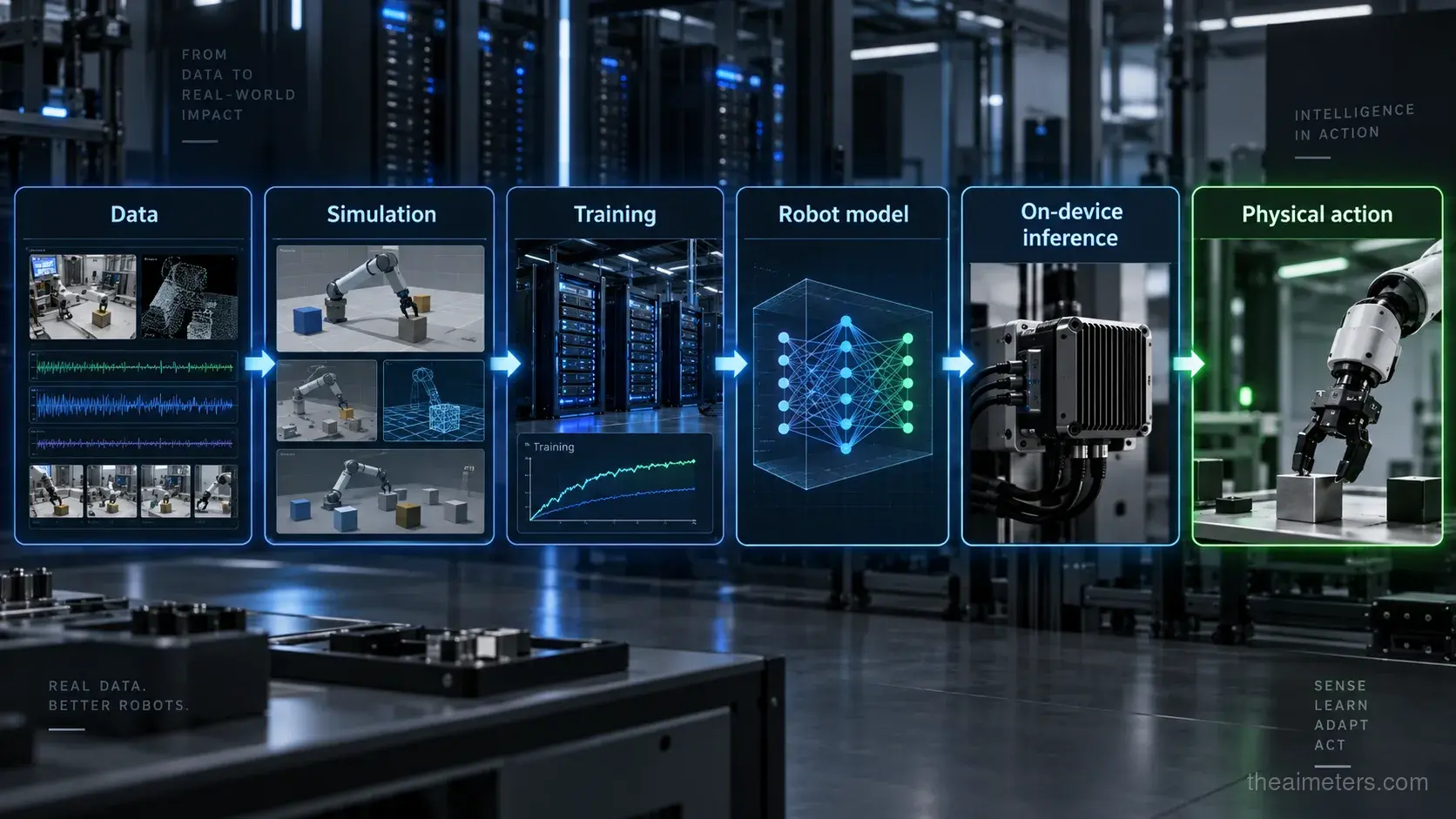
Robots can learn from many kinds of data: human demonstrations, teleoperation, sensor logs, videos, synthetic scenes, simulation environments and real-world trials. The goal is to expose the model to enough variation that it can handle tasks outside one perfectly scripted setup.
Simulation is especially important because collecting physical robot data is slow, expensive and sometimes risky. A simulated warehouse, lab bench or factory cell can generate many examples, test rare edge cases and train policies before they are deployed on real hardware.
The hard part is transfer. A behavior that works in simulation may fail when a real gripper slips, an object is heavier than expected or the lighting changes. This is why robotics teams combine simulation with real data, evaluation, fine-tuning and conservative deployment.
Where AI robots are used today
AI-powered robots are already useful in environments where tasks are repetitive, structured or safety-critical. Manufacturing robots can inspect parts, assist assembly or handle materials. Warehouse robots can navigate aisles, move inventory and support fulfillment workflows.
Robots are also used in agriculture, mining, logistics, medicine, laboratory automation, infrastructure inspection and public safety. In many cases the most valuable system is not a humanoid, but a specialized robot that does one job reliably in a constrained environment.
Humanoid robots attract attention because they could operate in spaces designed for people. They are still difficult to deploy broadly. Balance, dexterity, battery life, cost, reliability and safety remain major constraints, even as model quality and hardware improve.
Why robotics is harder than chatbots
Digital AI systems can run entirely inside datacenters and software products. Robotics has to deal with the physical world: friction, weight, force, changing light, uneven floors, fragile objects, moving people and hardware that wears out.
Latency also matters. A robot may need to react in milliseconds, not seconds. Some inference can happen in the cloud, but many decisions need to run on-device or near the robot so the system remains responsive even when connectivity is limited.
Safety is another major difference. A robotics system needs sensors, emergency stops, validated controllers, permissions, physical limits and human oversight. More capable AI models can make robots more flexible, but they do not remove the need for engineering discipline.
What comes next for physical AI
The direction is clear: robotics is moving toward models that can generalize across more tasks, learn from fewer demonstrations and adapt to different robot bodies. Open robotics datasets, simulation tools and robot foundation models are making experimentation easier.
The most likely near-term progress is not one universal household robot. It is better autonomy in warehouses, factories, labs, hospitals, farms, inspection workflows and vehicles, plus more capable research platforms for humanoids and mobile manipulators.
AI robotics will also increase demand for infrastructure. Training robot models can require simulation, GPUs, storage and evaluation pipelines. Deploying robots can require edge inference chips, networking, monitoring and reliable software updates. Physical AI is therefore part of the same infrastructure story as models, inference, GPUs and datacenters.